Monero or Bitcoin for a private purchase: what each one actually hides
What a Bitcoin payment reveals on-chain, what Monero hides by default, the trade-offs in speed and liquidity, and how to make either more private.
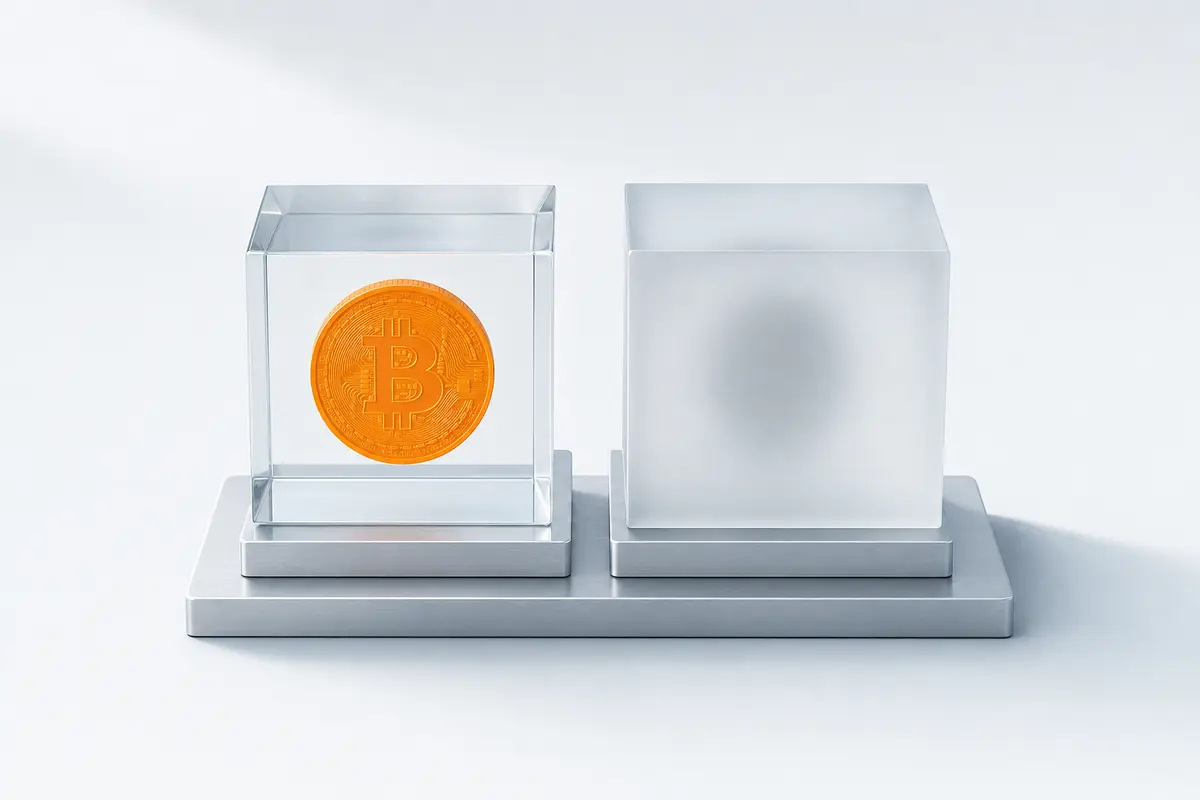
Both coins let you pay for something without a bank in the middle. That's where the resemblance ends. Bitcoin is a public ledger with pseudonymous addresses: nobody sees your name, but everybody sees the money move. Monero was built so that outsiders can't see who paid whom, or how much.
Which one you should use depends on what you're hiding, and from whom. This guide sets out what each coin reveals in practice, and how to get the most privacy out of the one you hold.
What a Bitcoin payment reveals
When you pay in bitcoin, the transaction records which earlier outputs you spent, the address you paid, the amount, and where your change went. All of it is visible to anyone, permanently, on any block explorer.
On its own, that's a string of addresses. The trouble is how easily addresses get tied to people:
- Exchanges. If you bought your bitcoin on a regulated exchange and withdrew it, the exchange holds your ID and the address it sent to. Exchanges also share data with analytics firms and, on request, with authorities.
- Address reuse. Every payment to or from a reused address joins the same public history.
- Clustering. Analytics firms assume that inputs spent together belong to one owner, and they spot which output is change. That lets them group many addresses into one wallet.
- Merchants. Any shop you pay knows which address paid it, and can see what that address did before and after.
None of this puts your name on the blockchain. It means that once one link to you exists, the rest of the trail is easy to read.
Making a Bitcoin payment more private
You can do a lot with habits alone:
- Pay from your own wallet, not straight from the exchange. That at least keeps the exchange from logging the shop as your destination.
- Use a fresh receiving address every time. Modern wallets do this by default.
- Use coin control. Wallets such as Sparrow let you pick which coins to spend, so you don't merge a coin tied to your exchange account with one you'd rather keep separate.
- Keep a separate wallet for purchases. Fund it once, spend from it, and don't send its change back to your savings.
- Hide your IP. Connect your wallet through Tor or to your own node, so the server you query doesn't learn which addresses are yours.
CoinJoin, where many people combine payments into one transaction to break the links, was the main heavier tool. After the 2024 prosecution of Samourai Wallet's developers, the best-known CoinJoin coordinators shut down. Check the current state of any such tool before you rely on it.
What Monero hides
Monero's privacy is on by default, for every transaction, with three tools working together:
- Ring signatures hide the sender. Each input is signed together with 15 decoys from the chain, so an observer can't tell which of the 16 is the real one.
- Stealth addresses hide the receiver. Each payment goes to a one-time address that only the recipient can recognise. Our published Monero address never appears on the chain.
- RingCT hides the amount. Amounts are encrypted, and the network checks they add up without seeing them.
An outside observer sees that a transaction happened, roughly when, and its fee. Not who, to whom or how much.
A larger upgrade, FCMP++, would replace the 16-member rings with proofs over the whole chain's history, making the sender set every output ever created. It has been running on a public stress-test network since early October 2026, and isn't on the main network yet.
Monero isn't magic. If you buy it on an exchange with your ID, the exchange still knows you bought it. If you tell a shop your name, the shop knows it. What Monero removes is the public trail between those points.
The trade-offs
| Bitcoin (on-chain) | Monero | |
|---|---|---|
| Sender visible on-chain | Yes | No |
| Receiver visible on-chain | Yes | No |
| Amount visible on-chain | Yes | No |
| Block time | About 10 minutes | About 2 minutes |
| Confirmation here | Automatic, after one confirmation | Checked by a person, usually within an hour |
| Network fee | Varies, a few hundred sats when quiet | About 1 cent |
| Easy to buy | Every exchange | Fewer exchanges since 2024 delistings |
| Wallets | Every crypto wallet | Feather, Cake Wallet, Monerujo, the official GUI |
The delistings matter. Binance, OKX and, for European customers, Kraken all removed Monero in 2024. You can still get it from exchanges that list it, from peer-to-peer markets, from decentralised exchanges such as Haveno, or by swapping bitcoin for Monero with an atomic swap tool.
Why is Monero confirmed by hand here? Because its privacy works against automatic checking too. We'd need to hand a view key to an outside service to watch payments, so a person checks each Monero payment instead. The exact amount on your payment page, down to the last digits, is how we find yours.
Which one should you use?
Use Bitcoin if you hold it already, you pay from your own wallet, and what you mainly want is to keep your name and card away from the AI vendor. For a ChatGPT or Claude plan, that's already a large step: the vendor sees a plan on your account and nothing about how you paid.
Use Monero if you don't want the payment linked to the rest of your coins at all, or if your bitcoin came from an exchange that knows you and you'd rather it didn't learn where it went.
Use either from your own wallet. Paying directly from an exchange gives the exchange the full picture, whatever the coin.
On the shop's side, we ask for no name and no account. An email is optional and erased 14 days after delivery, we don't store IP addresses, and the site works in Tor Browser with JavaScript off. See what we store.

ChatGPT
OpenAI
Claude
AnthropicHow to pay with each
For Bitcoin: choose Bitcoin at checkout, send the exact amount to the bc1 address within 30 minutes, and wait for one confirmation. The Bitcoin guide shows each wallet.
For Monero: choose Monero, send the exact amount from Feather, Cake Wallet or the official wallet, and a person confirms it, usually within an hour. The Monero guide walks through each wallet, and how to pay covers every other coin. How it works shows what happens after that. Either way, if we can't deliver within 24 hours of the payment confirming, you're paid back in full, in the coin you sent.
Questions about Monero and Bitcoin privacy
Is Bitcoin anonymous?
No. It's pseudonymous. Addresses don't carry names, but every payment is public, and one link to your identity exposes the history around it.
Can a Monero payment be traced?
Not from the blockchain alone, as far as public research shows. The sender, receiver and amount are hidden. It can still be linked to you through an exchange that sold you the coins, or through details you give the merchant.
Is it legal to pay with Monero?
In most countries, yes. A few exchanges dropped it under regulatory pressure, but owning and spending it remains lawful across most of the world. Your local law is what counts, so look it up. Sanctions evasion is off the table with any coin, ours included.
Why does a Monero payment take longer to be confirmed here?
Because a person checks it rather than an automatic watcher. Monero's privacy means we can't watch our address the way we watch Bitcoin's without sharing a view key. It's usually done within an hour.
Sources
- Bitcoin.org: protect your privacy
- Monero: what is Monero, ring signatures, stealth addresses and RingCT
- CryptoTicker: FCMP++ hits the stressnet
Buy ChatGPT or Claude with Bitcoin
Choose a plan and the country your account uses, settle in BTC, USDT, Monero or another coin, and it’s applied to your own account.
ChatGPT
OpenAIClaude
AnthropicRelated posts
Using paid AI without a credit card or an ID check
Clean ways to get ChatGPT, Claude and other paid AI with no card and no KYC, the shared-account offers to avoid, and where your coins' history matters.

Payment seen, then paid: how Bitcoin confirmations work when you buy something
What "payment seen" means, why a shop waits for a block, how many confirmations merchants ask for, and what to do when a Bitcoin payment sits unconfirmed.
Lightning, on-chain Bitcoin or USDT: what to use for a small online purchase
Fees, speed, privacy and refunds compared for Lightning, on-chain Bitcoin and USDT on a $50 to $200 purchase, and why this store takes on-chain BTC only.